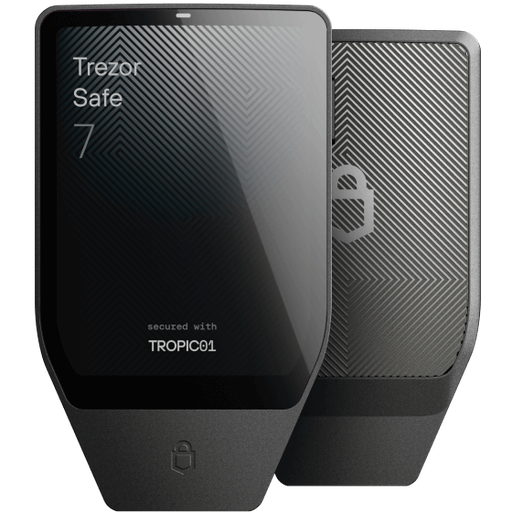
The short answerThe Safe 5 is the first Trezor that closes the gap that dogged its predecessors: a secure element resisting physical key extraction, alongside the fully open-source firmware and bootloader Trezor has always shipped. A large colour touchscreen makes verifying complex transactions genuinely readable.
Best forOpen-source purists who want a modern screen
Key isolationweight 25%
8.5avg 8.6
Firmware opennessweight 20%
10.0avg 7.8
Recovery designweight 20%
9.0avg 8.1
Asset coverageweight 15%
8.0avg 7.3
Vendor conductweight 10%
8.0avg 7.9
Usabilityweight 10%
9.0avg 8.1
this service category average across 15Score = Σ mark × weight. Recommendable to most readers, with stated caveats. Methodology.
| Criterion | Mark | What we found | Source | Checked |
|---|
| Key isolation | 8.5 | not sourced yet | not sourced yet | — |
| Firmware openness | 10.0 | not sourced yet | not sourced yet | — |
| Recovery design | 9.0 | not sourced yet | not sourced yet | — |
| Asset coverage | 8.0 | not sourced yet | not sourced yet | — |
| Vendor conduct | 8.0 | not sourced yet | not sourced yet | — |
| Usability | 9.0 | not sourced yet | not sourced yet | — |
What we liked, and what fell short
Liked- Entire stack open source, from bootloader to desktop suite
- Secure element addresses the physical extraction weakness of older models
- Large colour touchscreen makes verification genuinely readable
Fell short- Trezor's older models remain physically extractable and are still in circulation
- A 2022 support-vendor breach exposed customer contact data
Why the marks landed where they did
Trezor has been the openness benchmark since 2013, and for years it carried a real weakness: older models stored keys in a general microcontroller, and researchers demonstrated physical extraction with lab equipment. The Safe line fixes that with a certified secure element while keeping every line of firmware open to inspection.
What the screen buys you
Blind signing is how most experienced users lose money, and screen size is directly connected to it. The Safe 5's colour touchscreen renders contract interactions and addresses at a size where checking them is realistic rather than nominal. On a small monochrome display, people scroll past what they should be reading.
Backup options
Standard BIP39 seed, plus Shamir backup, which splits recovery into multiple shares of which a threshold is required. For anyone distributing backups across locations or trustees, Shamir is a meaningful improvement over a single phrase that is either intact or lost.
The company's record
In 2022 a third-party support vendor breach exposed Trezor customer contact details, which were subsequently used in phishing campaigns — a failure of vendor management rather than of the devices. Trezor's own firmware and hardware record remains strong, and its disclosure practice is good.
Who should use it
Users who want maximum verifiability with modern hardware and a screen that supports careful signing. Cost-sensitive buyers should take the Safe 3, which has the same security model with a smaller display.
FAQ
Do older Trezor models have a security problem?+
The Model T and One store keys in a general microcontroller, and physical extraction has been demonstrated with lab equipment and device access. The Safe line adds a secure element that addresses this.
What is Shamir backup?+
A scheme splitting your recovery into multiple shares, a threshold of which restores the wallet. It removes the single point of failure inherent in one written seed phrase.
Was Trezor hacked?+
The devices were not. In 2022 a third-party support vendor leaked customer contact data, which fuelled phishing campaigns against users.
Is Trezor's firmware really fully open?+
Yes — bootloader, firmware and desktop suite are open source and independently reviewable, which is the strongest openness position in this category.