







































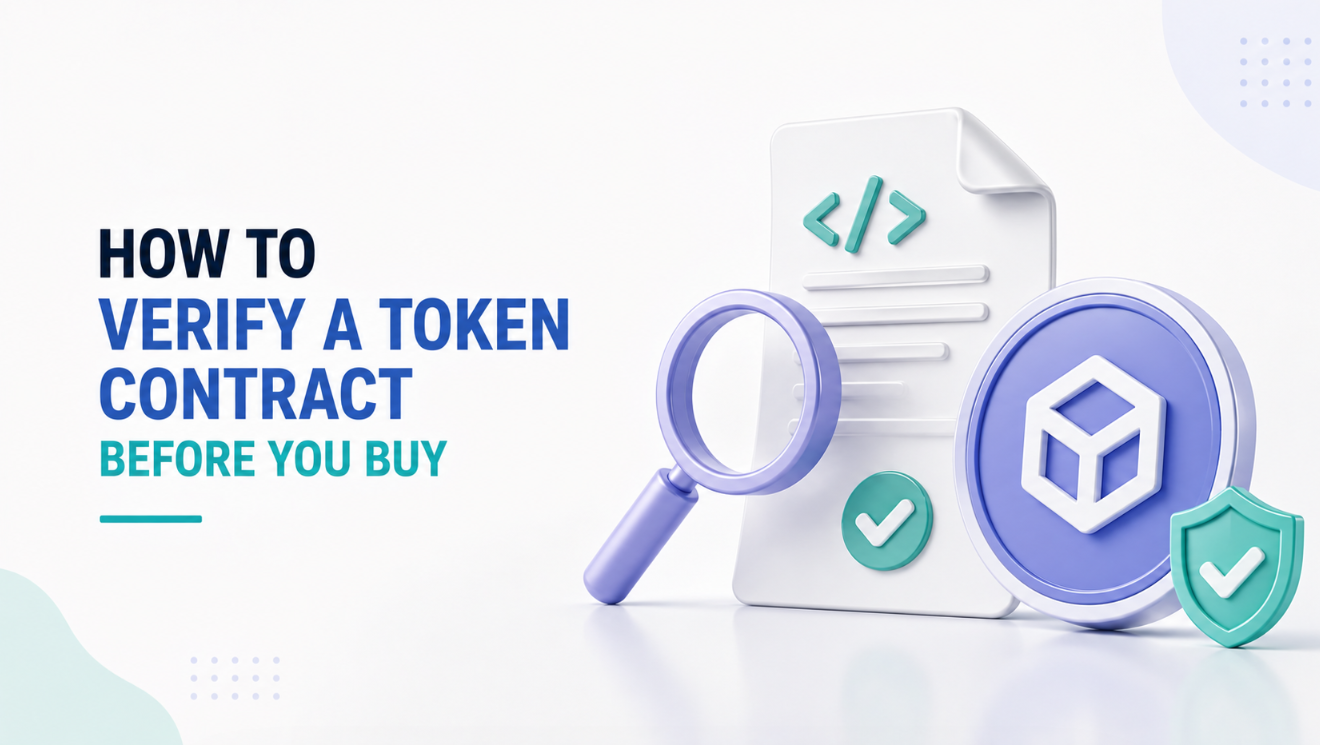
Before buying any token, verify you have the correct contract address from an independent source, then check holder concentration, whether liquidity is locked or removable, whether the contract can mint, blacklist, pause or tax transfers, whether ownership has been renounced or sits behind a timelock, and whether selling actually works. Most rug pulls and honeypots are identifiable from these fields in a few minutes.
- 1Check one: the address itself. Anyone can deploy a contract with any name and symbol.
- 2Check two: holder distribution. The explorer's holders tab shows the top addresses and their percentages.
- 3Check three: liquidity. Two questions.
- 4Check four: what the contract can do to you. Read the verified source, or use an explorer's read and write function lists, for these capabilities.
On this page8 sections
A token contract is public code with a public state. Nearly everything that will go wrong with a scam token is visible before you interact with it, and reading it does not require the ability to write Solidity — only knowing which fields to open.
Check one: the address itself
Anyone can deploy a contract with any name and symbol. There are dozens of tokens called USDC on chains where USDC exists and on chains where it does not.
Get the address from the project's own documentation, a major aggregator, and the chain's canonical token list, and confirm all three agree. Never take it from a social media post, an advertisement, a search result, or a message. Then paste it into a block explorer and check the deployment date and the contract's verified source — an unverified contract is one you cannot check at all, which is itself the answer.
Check two: holder distribution
The explorer's holders tab shows the top addresses and their percentages. What you are looking for is whether a small number of wallets can end the market.
Adjust for the legitimate cases — liquidity pool contracts, bridge contracts, staking contracts and exchange wallets are supposed to hold large balances. What remains is the discretionary supply. If a handful of externally owned addresses control a large share, the price is theirs to decide.
Follow the funding: if the top ten holders were all funded from one address in the same hour, they are one holder wearing ten hats.
Check three: liquidity
Two questions. How much liquidity exists, and can it be removed?
Liquidity is what lets you sell. A token with a large notional market capitalisation and a small pool cannot be exited at anything close to the quoted price — the mechanics are in order book depth and the AMM equivalent.
Whether it can be removed is the rug pull question. LP tokens held by the deployer can be withdrawn at any moment, taking the pool with them. Locked LP tokens in a time-locked contract, or burned ones, cannot. Check where the LP tokens are and, if locked, until when — a lock expiring in three weeks is a countdown, not a protection.
Check four: what the contract can do to you
Read the verified source, or use an explorer's read and write function lists, for these capabilities.
Mint. Can new supply be created after deployment, and by whom? An unrestricted mint function makes every other analysis irrelevant.
Blacklist or freeze. Can specific addresses be blocked from transferring? Legitimate for regulated stablecoins, a serious flag on anything else, because it is how a honeypot stops you selling.
Pause. Can transfers be halted entirely?
Transfer fees. Many tokens tax buys and sells. Check the rate and, more importantly, whether it is adjustable — a 5% tax that the owner can raise to 99% after you buy is a trap with a delay.
Max transaction and wallet limits. Sometimes anti-whale measures, sometimes a mechanism to prevent selling in size.
Check five: who controls it
Find the owner or admin address and what powers it holds. Ownership renounced to the zero address means the privileged functions are permanently unusable, which is good if the contract is otherwise sound and bad if it contains a bug.
Ownership held by a multisig with a timelock is the mature arrangement: changes are possible but visible in advance. Ownership held by a single externally owned account is one compromised key away from everything.
Also check whether the contract is behind an upgradeable proxy. If it is, the code you just read can be replaced, and the audit you found applies to a version that may not be running — the point made in reading an audit.
Check six: does selling work
The honeypot test. Simulate or execute a small sell before committing size. Several tools simulate buy-and-sell round trips and report the effective tax and whether the sell reverts; a small real trade answers it definitively.
A token you can buy and cannot sell is the single most common retail loss on new chains, and it costs a few dollars to rule out.
Check seven: the pattern, not the token
Step back from the contract and look for reused artifacts: a website cloned from another project, a team with stock photographs or no history, a whitepaper that appears elsewhere with different names, social accounts created weeks ago with engagement that does not match follower counts, and a deployer address that has deployed twenty similar tokens in a month.
That last one is the strongest single signal available, and it takes one click on the explorer's deployer address.
Tooling and limits
Automated contract scanners and analytics tools run most of these checks in seconds and are worth using as a first pass. Treat them as a filter rather than a verdict: they flag known patterns and miss novel ones, and a clean report on a three-day-old token means only that it does not resemble last month's scams.
None of this establishes that a token is a good investment. It establishes that the mechanism to take your money by force is absent — which leaves only the ordinary risk that the thing is worthless. For anything outside the assets covered on our market pages, assume you are the exit liquidity until the checks above say otherwise.
Next step
Understood the mechanics? Keep going, or compare the services.
FAQ
How do I check if a token is a scam?
What is a honeypot token?
Does renounced ownership mean a token is safe?
Why does locked liquidity matter?
Related guides
All guides →- How to Use a Blockchain Explorer to Track Any TransactionA blockchain explorer turns an impenetrable string of numbers into a readable record of who sent what, when, and whether it actually confirmed.Beginner8 min
- Restaking Slashing: What Can Actually Take Your PrincipalOrdinary staking risks a penalty defined by one protocol. Restaking risks penalties defined by every service your operator opted into.Advanced10 min
- Wrapped Assets: Who Holds the Collateral Behind Your TokenWrapped BTC on Ethereum is not Bitcoin. It is an IOU whose value depends entirely on whoever holds the Bitcoin behind it.Intermediate9 min
- What Proof of Reserves Actually Proves (And What It Doesn't)A Merkle-tree snapshot is evidence, not a solvency statement. Here is exactly what an exchange proves when it publishes reserves, and the three gaps every programme leaves open.Intermediate8 min