












































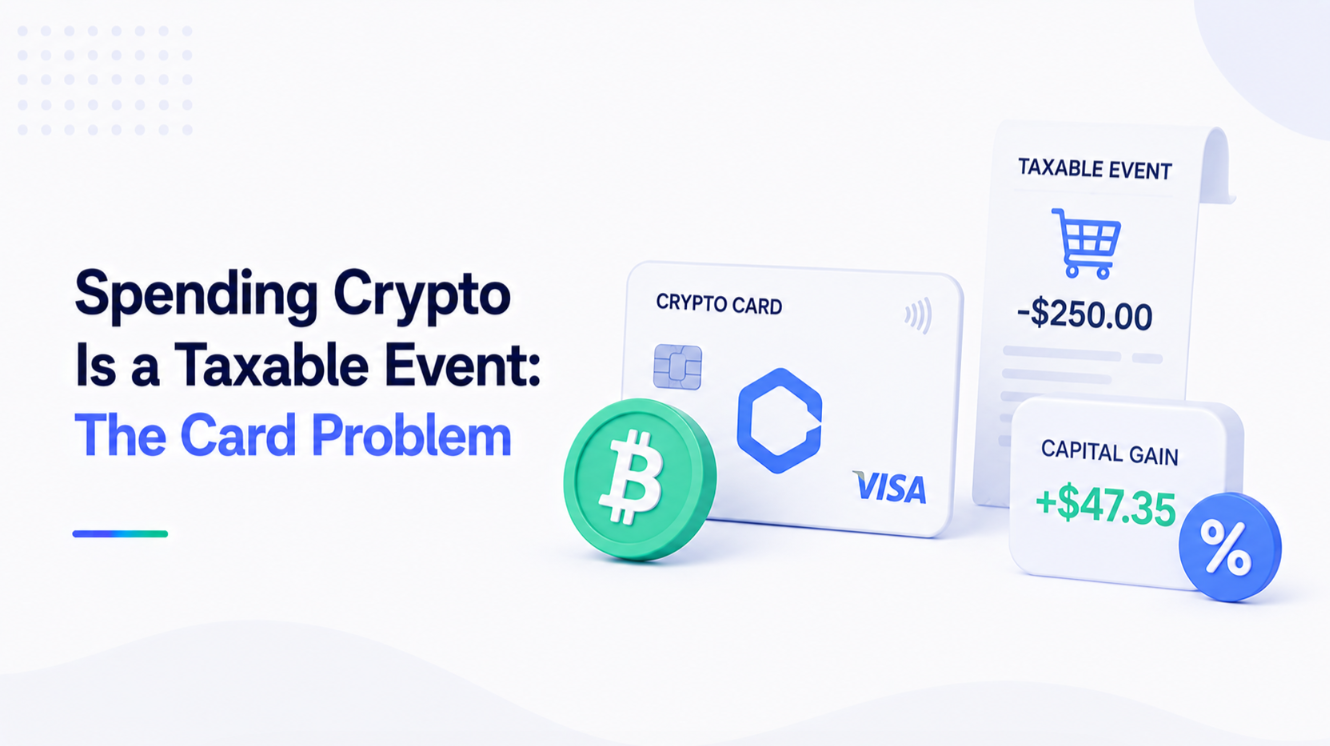
Most tax authorities treat paying for goods with cryptoassets as a disposal, producing a capital gain or loss measured against the cost basis of the units spent. A card used daily therefore creates hundreds of small taxable events, each needing a date, a fiat value and a matched acquisition. Spending from a stablecoin balance keeps gains near zero, and some jurisdictions offer small-transaction relief — but the record-keeping obligation usually remains.
- 1The mechanics of one coffee. You pay €4 with a card funded from BTC.
- 2Why the amounts are small and the problem is not. The gain on any single transaction is trivial.
- 3Small-transaction relief, where it exists. Some jurisdictions provide a de minimis exemption for personal transactions below a threshold, and proposals to introduce one in the US have…
- 4The structural fix. Spend from a stablecoin balance rather than from a volatile asset.
On this page6 sections
The appeal of a crypto card is that it removes a step: no selling, no bank transfer, just pay. The tax treatment does not recognise that convenience. In the eyes of most authorities you sold the crypto and used the proceeds, and the fact that both halves happened inside one card transaction changes nothing.
This is general information about how the rules work, not advice on your position.
The mechanics of one coffee
You pay €4 with a card funded from BTC. To report it correctly you need: the date and time, the quantity of BTC disposed of, its fiat value at that moment, the acquisition cost of those specific units under whichever matching rule applies in your jurisdiction, and the resulting gain or loss.
That is a full capital gains calculation for a coffee. Do it twice a day for a year and it is roughly seven hundred of them, each with its own cost basis lookup.
The matching rule is what makes it genuinely difficult rather than merely tedious. Under UK pooling, each disposal takes a proportional slice of the section 104 pool, and the 30-day rule can match a spend against a purchase made weeks later. In the US, basis must be tracked per account or wallet and identification made at the time. In Germany, each disposal has to be matched against a specific acquisition date to determine whether the one-year period has passed.
Why the amounts are small and the problem is not
The gain on any single transaction is trivial. The obligation is not proportional to the gain — it attaches to every disposal regardless of size, and it accumulates.
Worse, the small transactions interact with the large ones. Spending disposals draw down the same pool your investment sales draw from, so a year of card use changes the cost basis applied to a significant sale. Ignoring the small transactions therefore produces a wrong answer on the big one, not merely an incomplete record of the small ones.
Small-transaction relief, where it exists
Some jurisdictions provide a de minimis exemption for personal transactions below a threshold, and proposals to introduce one in the US have appeared repeatedly without being enacted. Where such a rule exists it usually has conditions — a per-transaction cap, a personal-use requirement, sometimes an annual limit — and it typically exempts the tax rather than the record-keeping.
Do not assume one applies. Check the specific rule in your jurisdiction, and note that a relief for personal spending does not extend to spending that is part of a trading pattern.
The structural fix
Spend from a stablecoin balance rather than from a volatile asset.
The disposal still occurs, but the gain is close to zero because the asset barely moves against the currency you are spending. That converts each transaction from a calculation into a formality, and it removes the interaction with your investment cost basis almost entirely.
There is a second benefit: it also removes the conversion spread on volatile assets, which is the largest hidden cost of a crypto card, as set out in what a crypto card really costs.
The clean version of this is to decide when you sell — a deliberate conversion of crypto to stablecoins at a moment you choose, recorded once — and then spend the stablecoins over the following months. One meaningful disposal to calculate instead of several hundred.
Practical record-keeping
Whatever you spend, the requirement is the same: a per-transaction record with date, asset, quantity, fiat value at the time, and the merchant. Card issuers vary enormously in what they export; check before you commit to one, because reconstructing a year of card spending from statements that show only the fiat amount is close to impossible.
Export monthly. Keep the export in a format your tax software or accountant can ingest, and keep the raw file too. The crypto card ratings note export and statement quality where issuers differ, because for anyone in a jurisdiction that taxes disposals it is a more consequential feature than cashback.
Two things that are not disposals
Worth stating for contrast. Loading a card with fiat you already hold is not a disposal. Moving crypto between your own wallets is not a disposal. And in most jurisdictions, borrowing against crypto rather than selling it is not a disposal either — which is why some people spend from a stablecoin loan against collateral rather than from the collateral itself. That introduces liquidation risk in exchange for deferring the tax event, which is a real trade with a real failure mode, not a loophole.
Next step
Understood the mechanics? Keep going, or compare the services.
FAQ
Is spending crypto a taxable event?
Does using a crypto card create tax obligations?
How do I avoid tax complexity with a crypto card?
Is there a small-transaction exemption for crypto spending?
Related guides
All guides →- Crypto Taxes 101: What Every Beginner Needs to KnowThe taxable events every new crypto holder needs to track from day one — trades, swaps, staking rewards and more — explained without the jargon.Beginner9 min
- Crypto Tax in the UK: HMRC Rules for Traders and StakersHMRC treats crypto as property, not currency. That single decision drives the pooling rules, the 30-day rule and why swapping one token for another is a taxable event.Intermediate11 min
- What a Crypto Card Really Costs: Spread, FX and ATM FeesThe headline is cashback. The cost is a conversion spread you cannot see, applied to every transaction, plus network FX on anything abroad.Beginner8 min
- Crypto Tax in Germany: The One-Year Rule ExplainedGermany's treatment is unusually favourable and unusually specific. The whole framework turns on one date and on whether the activity stays private.Intermediate11 min