






































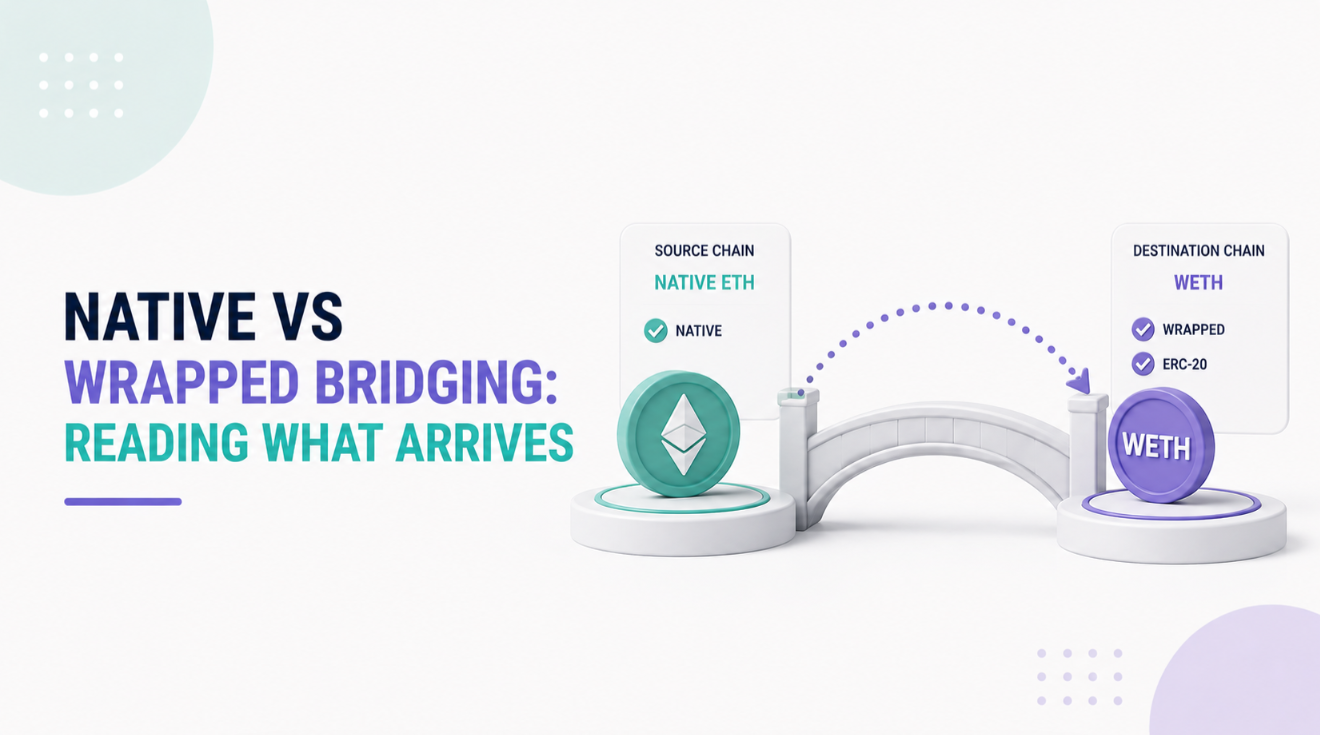
A native transfer burns the asset on the source chain and mints the issuer's canonical token on the destination, so what arrives is fungible with everything else. A wrapped transfer locks the original in a bridge contract and mints a bridge-specific representation whose value depends on that bridge remaining solvent. Check the destination token's contract address against the issuer's official list before bridging, and prefer native routes wherever they exist.
- 1Wrapped: the lock-and-mint model. The bridge takes custody of your asset on the source chain and mints a representation on the destination.
- 2Native: the burn-and-mint model. When the asset's issuer supports it, no bridge is required.
- 3The middle case: canonical chain bridges. Most rollups operate an official bridge whose output the ecosystem treats as canonical.
- 4Telling them apart before you sign. The token symbol will not tell you.
On this page6 sections
You bridge USDC to a new chain, and your wallet shows USDC. Whether that balance is the same asset everyone else on the chain is using, or a bridge-specific token that will be worth nothing if that bridge is exploited, is decided by which route you took — and both routes are labelled the same way in most interfaces.
Wrapped: the lock-and-mint model
The bridge takes custody of your asset on the source chain and mints a representation on the destination. That representation is a liability of the bridge, redeemable one-for-one as long as the locked reserves are intact.
Three consequences. If the bridge is exploited, the reserves leave and the wrapper loses its backing while the original asset is unaffected — the outcome in every large bridge failure. If several bridges serve the same chain, each mints its own incompatible version, splitting liquidity across tokens with the same name. And redemption depends on the bridge continuing to operate; a paused or abandoned bridge leaves holders with an asset that cannot go home.
The custody arrangements behind these wrappers are covered in wrapped assets; the trust models that decide whether the bridge holds up are in bridge trust models.
Native: the burn-and-mint model
When the asset's issuer supports it, no bridge is required. The issuer destroys the tokens on the source chain and issues new canonical tokens on the destination, verified by the issuer's own attestation.
What arrives is the real asset. It is fungible with every other unit on that chain, accepted everywhere, and carries no bridge exposure at all — the only trust is in the issuer, which you already accepted by holding the token.
Circle's CCTP is the reference implementation for USDC and supports a growing set of chains. Other issuers have adopted the same pattern, and several tokens now use standards that let the issuer control cross-chain issuance directly rather than delegating it to third-party bridges.
The middle case: canonical chain bridges
Most rollups operate an official bridge whose output the ecosystem treats as canonical. It is technically a lock-and-mint wrapper, but because it is the chain's own bridge and everything on that chain uses its output, liquidity is concentrated rather than fragmented.
Security is the chain's bridge contract, which for major rollups is among the most reviewed code in the ecosystem. Withdrawals back to the source may be slow — an optimistic rollup's challenge period is measured in days — which is why fast third-party routes exist alongside it.
Telling them apart before you sign
The token symbol will not tell you. The contract address will.
Take the destination token's contract address from the bridge's confirmation screen and compare it against the issuer's official address for that chain, published in their documentation and in the major token lists. If they match, you are getting the canonical asset. If they do not, you are getting a wrapper, whatever the interface called it.
Two other signals. Look at the token name closely: variants like USDC.e, wrapped-prefixed names, or a bridge's initials indicate a wrapper. And check which version the destination chain's main DEXs and lending markets actually use — liquidity concentrates on the canonical version, and a wrapper with thin pools is expensive to convert out of.
When a wrapper is acceptable
It often is, with two conditions: it is the chain's canonical bridged version rather than one of several competing ones, and you are not holding it for long. Bridged exposure measured in minutes while you complete a transaction is a very different risk from a position held for months.
It is not acceptable as a long-term store, as collateral you cannot monitor, or where a native route exists and you simply did not check.
A working procedure
Before bridging: check whether the issuer offers a native route for that asset and chain, and use it if so. If not, prefer the chain's canonical bridge for anything you will hold, and a fast third-party route only for amounts you are moving through.
After bridging: verify the received contract address against the official list before depositing it anywhere. And if you end up holding a non-canonical wrapper, swap it for the canonical version on arrival — the cost is a small swap fee and it removes the entire bridge exposure from the position. The bridge ratings note which routes deliver native assets for exactly this reason; it is the single most consequential difference between two bridges that otherwise look identical.
Next step
Understood the mechanics? Keep going, or compare the services.
FAQ
What is the difference between native and wrapped bridging?
How do I know if I received wrapped or native tokens?
Is it safe to hold bridged tokens?
Why are there several versions of USDC on one chain?
Related guides
All guides →- Wrapped Assets: Who Holds the Collateral Behind Your TokenWrapped BTC on Ethereum is not Bitcoin. It is an IOU whose value depends entirely on whoever holds the Bitcoin behind it.Intermediate9 min
- How Cross-Chain Bridges Work (and Why They're Risky)Cross-chain bridges move billions between blockchains every week — and have lost billions more to exploits. Here's how the plumbing actually works and how to size up the risk before you use one.Intermediate12 min
- Bridge Trust Models Compared: Light Client, Validator Set, IntentBridges have lost more value than any other category in crypto, and almost always at the same point: whoever attests that funds arrived on the other side.Intermediate12 min
- How to Use a Blockchain Explorer to Track Any TransactionA blockchain explorer turns an impenetrable string of numbers into a readable record of who sent what, when, and whether it actually confirmed.Beginner8 min