













































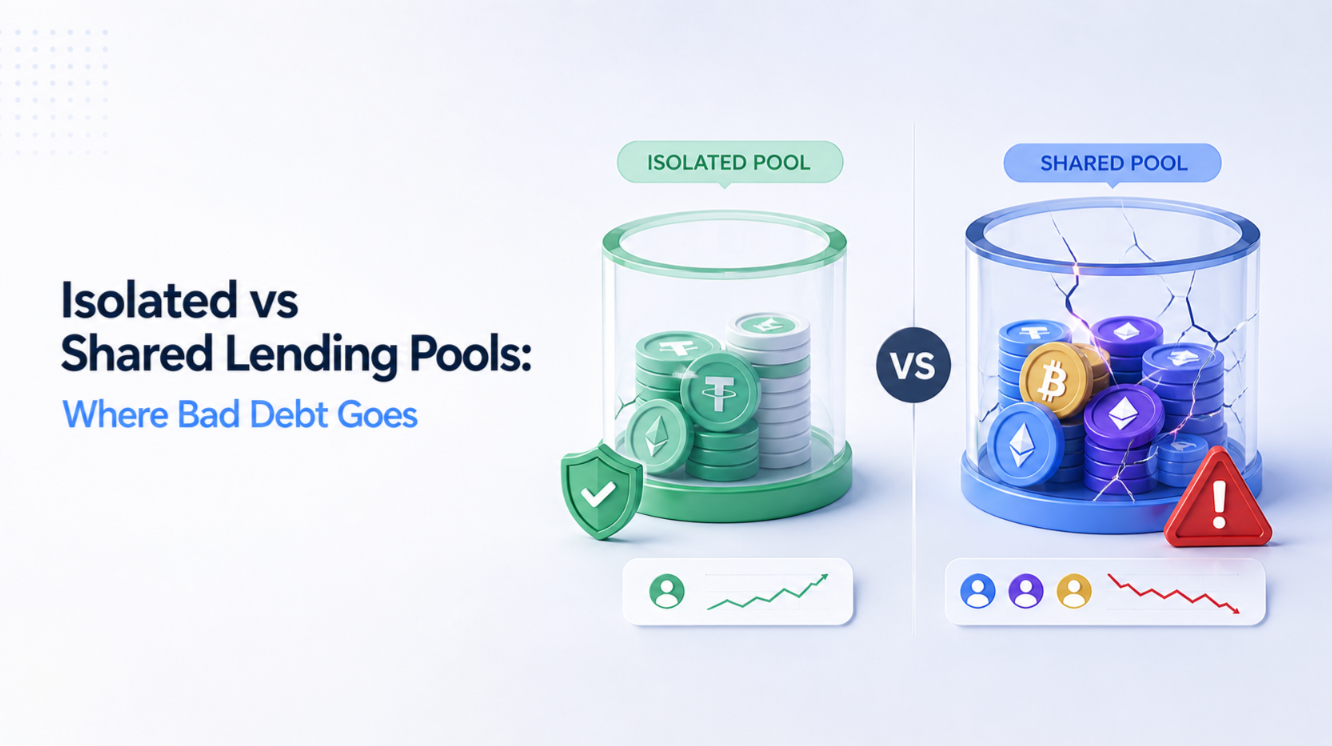
A shared pool lets one liquidity base back loans against many collateral types, which concentrates liquidity but socialises any bad debt across all depositors. An isolated market pairs one collateral with one borrowable asset, containing losses to the lenders who chose that pair but fragmenting liquidity. Modern designs layer a shared deposit experience over isolated markets, with a curator selecting which markets receive funds — which moves the risk decision to the curator.
- 1The shared pool model. One pool of each asset, many accepted collaterals.
- 2The isolated market model. One collateral asset, one borrowable asset, its own parameters and its own oracle.
- 3The layered model, and the curator. The current synthesis is a vault sitting over isolated markets.
- 4Questions to ask before depositing. Which collateral assets can borrow against my deposit?
On this page5 sections
When you supply USDC to a lending protocol, the question that determines your worst outcome is not what rate you earn. It is which borrowers can draw on your deposit and what they pledged against it.
The shared pool model
One pool of each asset, many accepted collaterals. Borrowers pledge from a list of approved assets and draw from the common liquidity. This is the design of the largest and longest-running markets, including Aave in its main configuration.
The advantages are real. Deep liquidity in one place means large borrows without moving rates. Depositors get a single position rather than a dozen. Cross-collateralisation lets a borrower pledge several assets against one loan, which is more capital efficient and reduces liquidation frequency.
The cost is loss socialisation. If a collateral asset gaps down and liquidations leave a shortfall, the bad debt lands on the pool. Every depositor in that asset absorbs a share, whether or not they had any view on the collateral that failed.
This is why listing decisions in shared pools are so contested. Adding a thin, manipulable asset as collateral imports its risk into everyone's deposit, and the history of DeFi lending includes several incidents where exactly that happened through oracle manipulation on an illiquid listing.
Mature shared pools mitigate it: conservative listing standards, supply and borrow caps per asset, an isolation mode for riskier collateral that restricts what can be borrowed against it, and a safety module funded by staked tokens that absorbs shortfalls first. Those mitigations work, and they are the reason the model remains dominant.
The isolated market model
One collateral asset, one borrowable asset, its own parameters and its own oracle. Lenders choose the specific pair they underwrite, and bad debt in that market touches only its lenders.
The benefits follow directly. Risk is legible: you can read the loan-to-value, the oracle and the liquidation parameters for the exact pair you are exposed to. Listing is permissionless, because a bad market can only harm those who entered it. And a failure is contained rather than systemic.
The costs are fragmentation and effort. Liquidity splits across many markets, so depth per market is lower and rates are more volatile. Borrowers cannot cross-collateralise. And a depositor now has a portfolio of decisions rather than one, which most people will not make well.
The layered model, and the curator
The current synthesis is a vault sitting over isolated markets. Depositors put assets into a vault; the vault allocates across underlying isolated markets according to a risk policy; the depositor sees one position and one rate.
Morpho is the clearest implementation. The isolated markets are immutable primitives with fixed parameters; the vaults on top are managed by curators who decide which markets to allocate to and with what caps.
This resolves the usability problem and relocates the risk question. You are no longer underwriting every asset a governance vote approved, and you are no longer picking markets yourself — you are trusting a curator's allocation policy. That makes the curator's identity, track record, incentives and the vault's caps the thing to evaluate, which is the subject of curators and risk managers.
Questions to ask before depositing
Which collateral assets can borrow against my deposit? In a shared pool, all of the approved ones. In an isolated market, exactly one. In a curated vault, whichever markets the curator has allocated to — which changes over time and should be visible.
Where does bad debt land? Socialised across depositors, contained to the market, or absorbed first by a safety module or insurance layer?
Are there supply and borrow caps per asset, and how were they set? Caps are the difference between a bad listing being an incident and being a catastrophe.
What oracle does each market use, and how manipulable is the price of the collateral? Thin collateral plus a spot oracle is the recurring cause of lending losses.
What is the utilisation, and can I withdraw? High utilisation means good rates and no exit until borrowers repay or are liquidated. That is a liquidity risk distinct from credit risk and it bites at the same moments.
Choosing
For stablecoin deposits where capital preservation is the point, a mature shared pool with conservative listings and a funded safety module is the most tested option. For higher yield with a legible risk, an isolated market against collateral you understand and would be content to hold. For a middle path, a curated vault from a curator whose policy and history you have actually read.
What does not work is depositing into whichever venue shows the highest rate. That rate is compensation for something, and in lending markets the something is almost always the collateral you did not look at — which is why the lending ratings score market structure, listing governance and bad-debt history rather than ranking by yield.
Next step
Understood the mechanics? Keep going, or compare the services.
FAQ
What is the difference between isolated and shared lending markets?
Who absorbs bad debt in a DeFi lending protocol?
What does a vault curator do?
Can I always withdraw from a lending pool?
Related guides
All guides →- Concentrated Liquidity: Why LPs Lose Money in RangesChoosing a price range is choosing leverage. The fees rise, the divergence loss rises with them, and most range positions underperform simply holding.Advanced11 min
- Impermanent Loss Explained: The Hidden Risk of Providing LiquidityProviding liquidity looks like free yield until you compare it against simply holding the two assets — the gap between those outcomes is impermanent loss, and it's bigger than most LPs realise.Intermediate11 min
- Optimistic vs. ZK Rollups: How Layer 2 Scaling Actually WorksA side-by-side breakdown of the two dominant rollup architectures, what each trades away to scale Ethereum, and where the gap between them is closing.Intermediate13 min
- Restaking Slashing: What Can Actually Take Your PrincipalOrdinary staking risks a penalty defined by one protocol. Restaking risks penalties defined by every service your operator opted into.Advanced10 min